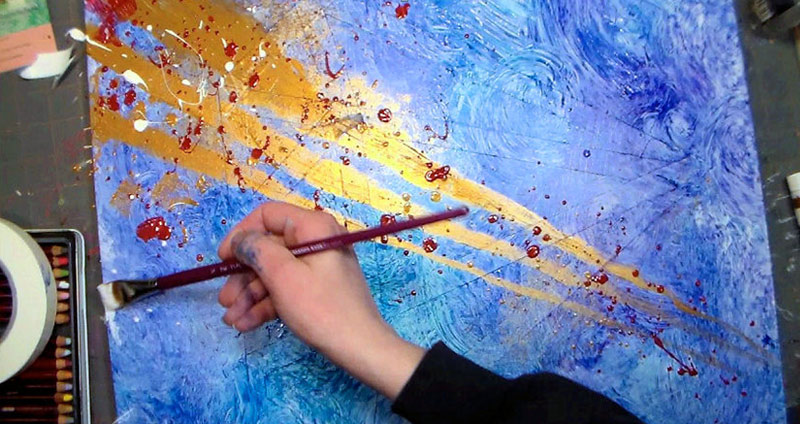
Showing posts with label painting. Show all posts

Monday, February 15, 2021

Where to find inspiration for your paintings


While many may claim that learning photography is easy, every student reaches a plateau where they feel like they can’t learn anything more unless they are presented with vastly different situations, where they would need to adjust for them to learn how to adjust. According to avid photographer Vijaya Prakash Boggala, challenging ourselves is a great way to gain experience and learn more as a photographer. Here are some easy-to-do photo projects for absolute beginners.

Image source: diyphotography.net


One subject, 10 ways
Take one subject and photograph it in 10 different ways. What ways can you utilize? That’s up to you. Black and White, blurred background, macro, using leading lines, just make sure you can reach 10. It also helps if you give yourself a deadline, like an hour to accomplish everything. A ramped-up version of this challenge is to do one subject and find the many ways to photograph it within one day, provided a day of preparations.

Portraits One important aspect of shooting people is the social interaction. Some photographers find it awkward to talk to people when asking to take their portraits. This can help you iron out small necessities while still working on your photography skills.

Image source: youtube.com


Turning off auto focus
When you turn autofocus off, your camera becomes a much harder gadget to operate. A lot of photographers rely on the autofocus mode, but hardly gets better because they are already satisfied with that mode. Vijaya Prakash Boggala claims that forcing yourself to take care of everything manually allows you to learn and really understand the capability of your camera.

Vijaya Prakash Boggala enjoys oil and acrylic painting and is also currently developing his skills in photography through action photography, slow shutter speed photography, and landscape photography among his favorite approaches. For more reads on photography, visit Vijaya’s blog here.

Monday, March 30, 2020

The different kinds of paint artists can use for their projects

Image source: Pexels.com
During his free time, medical abstractor Vijaya Prakash Boggala dabbles in art and photography. These pursuits are a great way to use one's creative energy. It's important to have the right materials to create good work. For visual artists, this means using the right kind of paint. What are the types of paint commonly used by artists?

Acrylic: For artists on a budget, acrylic is usually the best option. It can also be used on paper, canvas, wood, and even metal. Those who want a water-based material for projects can use this type of paint. Kids can also use this paint for quick and fast-drying DIY projects. However, brushes must be cleaned immediately after use for the paint can harden the bristles.

Image source: Pexels.com
Oil: Artists have been using oil-based paint for centuries. This kind of paint produces rich pigments perfect for creating texture. According to Vijaya Prakash Boggala, one needs to be careful when using oil as it can be messier than other types of paint. It can also take a long time to dry. This kind of paint blends well, allowing artists to improve details on their work further.

Watercolor: This kind of paint is probably the most commonly used among beginners. Watercolor is paint suspended in a water-based solution. While most artists use this paint with paper, this can also work with fabric, wood, and leather. The transparent layer it creates is also suitable for blending and layering.

Understanding when and how to use different kinds of paint will help artists find the most suitable type for their project. Practicing with paint help in polishing the skills of artists of all levels.

Vijaya Prakash Boggala writes medical abstracts for a living. Aside from doing art projects, he also enjoys watching live sports such as cricket, basketball, and tennis. Subscribe to this blog for more updates.

Tuesday, November 5, 2019

Why you should use acrylic paint on wood crafts

For those who love working with wood crafts (or as a pet project) during their free time but are still undecided on the right kind of paint to use, acrylic is the way to go, advises hobbyist painter and DIY enthusiast Vijaya Prakash Boggala. Acrylic is highly recommended because it mixes readily with water, allowing you to easily blend and experiment with various colors.
Image source: thesprucecrafts.com

Acrylic is ideal for wood, which quickly absorbs moisture. It is unlike the non-porous canvas. Acrylic paints are themselves highly porous, quickly permeating the wood and drying between the coats. When acrylic gets dry, it becomes highly water resistant and stays on wooden blocks for years. This equates to less maintenance coupled with durability.

Acrylic paints are also less opaque and thinner, which makes them best suited for wood as opposed to other types of paints, like oil. Which is why most manufacturers of wooden crafts and wooden blocks will say that acrylic is best for a variety of projects, from accents to wall décor and birdhouses.

Image source: ebay.co.uk
You’d likewise only need a small amount of acrylic paint on your wood projects, as acrylic has a low viscosity. Moreover, it is non-toxic, making it safe especially if you have kids at home who’d be inclined to play with wooded blocks. Lastly, acrylic is both readily available everywhere and is generally inexpensive, Vijaya Prakash Boggala adds.

Vijaya Prakash Boggala writes abstracts for published medical literature. He is also an avid painter who favors using acrylic and oil on different media, most often wood and canvas. Visit thisblog for similar posts.

Tuesday, May 16, 2017

The Best Surfaces For Acrylic Painting

Choosing which surface to paint on is as important as selecting the art medium. And for those who want to use acrylic as material, the painting surface should not be too greasy nor glossy. Here are some of the best ones to use:

Image source: craftsy.com


Canvas

The most common surface used by artists, canvas is also an ideal choice for acrylic painters because of the ease of working on it coupled with its affordability. Acrylic also does not degrade the fibers of canvas as time passes, which means that there is no more need to prime the canvas.

But because linen canvas has a smooth, stiff surface, it is not that recommendable for acrylic painting. It is better to opt for a raw cotton canvas.

Paper

Paper is another perfect painting surface for acrylic because of its texture. Take note, however, that acrylic contracts when it dries, rendering thin paper impractical. The paper’s edges can be secured by applying removable tape on the edges, preventing it from wrinkling or warping too much. A thicker type of paper can also be used.

Image source: jerrysartarama.com


Board

Initially introduced to facilitate painting outdoors, artists have also started to prefer art boards even when indoors as it can be convenient for some. Examples of art boards that are ideal for acrylic painting are canvas boards, museum boards, fiber boards, and wooden boards.

Vijaya Boggala is a medical abstract writer who has an affinity for the arts. He enjoys oil and acrylic painting, and is currently developing his photography skills. Learn more about him by checking out this link.


Wednesday, June 22, 2016

Choosing The Right Paint: Acrylic Vs. Oil

Image source: wisegeek.com
For beginners, choosing the right paint for their artwork can be a challenge. While a lot of people debate on which kind of paint is better, it really does not matter. But here are key differences between the two kinds. 

A noticeable difference between the two is that acrylic paints dry faster than oil. It can dry up completely after an hour, or even within 15 minutes. Oil paintings require longer drying time. It may take a few days or even weeks depending on how much paint was used and the current ground temperature.

Oil paints have more pigment compared to acrylics and are usually richer and more vivid in color. It can maintain its original color as it dries, unlike acrylic paint, which darkens slightly as it dries. 
Image source: pinterest.com

Acrylic paints are more versatile compared to oil, and can be expanded with water (they may give off a light watercolor effect). But painters can develop new color blends with oil, too, without compromising its pigment. If budget is a concern, acrylic is a better choice over oil as it is more affordable. 

Vijaya Prakash Boggala write medical abstracts and is fond of doing a lot of art and DIY projects. Learn more about his artistic journey by visiting this Facebook page.